Your team already runs on WhatsApp, but tasks still slip through. Voice notes get buried, deadlines pass unnoticed, and no one knows who confirmed attendance at the site. Choosing a task tool that syncs across cloud and chat is now a real decision, not a preference.
This comparison covers how Tasks.Bot handles AI task automation and cloud sync inside WhatsApp, where TaskRio may suit different workflows, and what pricing, beta status, and security signals mean for your team. By the end, you will know which platform fits your operation.
What Is Tasks.Bot? AI Task Automation That Lives in WhatsApp
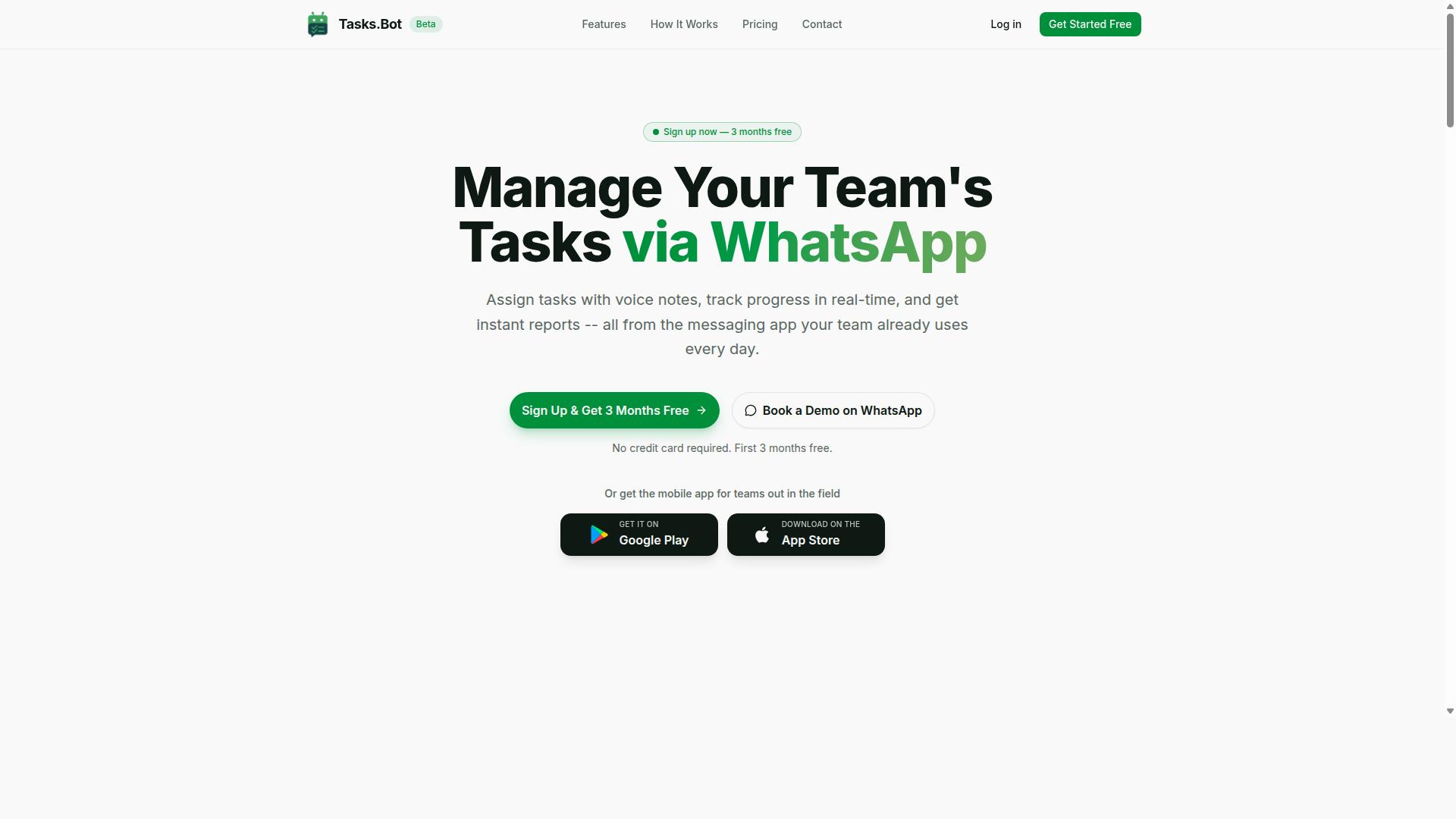
Tasks.Bot is a task management platform that operates entirely within WhatsApp, allowing teams to assign tasks, track progress, and receive reports without leaving the messaging app. For teams already using WhatsApp as their main communication channel, this removes the friction of switching between a chat app and a separate productivity tool.
The core idea is simple: instead of asking people to log into yet another dashboard, Tasks.Bot turns the conversations and messages a team already sends into structured task management. Work gets captured, assigned, and followed up in the same place where coordination already happens.
Tasks.Bot also offers a mobile app built for field teams, so workers who are away from a desk can still capture and manage tasks. The platform is currently in beta and includes a free trial period, which lets teams evaluate it before committing.
Beyond basic task creation, the platform covers a broad set of operational needs, including:
- Voice note task creation
- Automatic task assignment
- Smart deadline reminders
- Approvals and automations
- Instant reports
- Tasks on a map
- Live day tracker
- Face-verified attendance
- Shifts, leave, and hours management
- Native WhatsApp integration
This combination positions Tasks.Bot as more than a simple to-do list. It blends task management, lightweight field coordination, and reporting into one place, which is why the next section looks closely at how its AI and cloud sync actually work.
How Tasks.Bot Handles Cloud Sync and AI Task Automation
Tasks.Bot leverages AI to understand natural language and voice notes, automating task creation, assignment, and reminders while keeping all data synced across devices via its cloud infrastructure. That means a message typed or spoken in WhatsApp can become a tracked task without manual data entry.
The AI layer focuses on understanding user intent. Rather than requiring a rigid form or template, the platform interprets what a person means and turns it into a task from the message itself. Voice note task creation extends this further, so a quick spoken update can be captured as structured work.
From there, automation takes over several routine steps:
- Automatic task assignment, so work reaches the right person without a manager manually routing it
- Smart deadline reminders, which keep time-sensitive items visible
- Approvals and automations, giving teams a way to sign off on work as part of the flow
Cloud sync is what holds this together. Because tasks and updates live in shared cloud infrastructure, they remain available across both WhatsApp and the Tasks.Bot mobile app. A field worker can update something on a phone and a coordinator can see it reflected in the chat, supporting cross-device synchronization and real-time collaboration.
Reporting rounds out the picture. Instant reports mean progress can be reviewed without manually compiling status updates, which is useful for teams tracking shifts, attendance, and daily activity. The Android and iOS apps add push notifications, voice capture, and a home screen widget, so the same task data stays within reach on the go.
For teams weighing AI task automation and cloud sync, the takeaway is that Tasks.Bot keeps the workflow anchored in WhatsApp while using AI and the cloud to handle the busywork behind the scenes.
TaskRio vs Tasks.Bot: Which Fits AI Task Automation Cloud Sync?
When comparing TaskRio and Tasks.Bot for AI task automation with cloud sync, the choice often comes down to whether your team prioritizes a WhatsApp-native experience or a more traditional task management interface.
Both products sit in the same broad category of productivity software: they use AI to capture work items and keep them synchronized across devices. Beyond that shared ground, their design philosophies pull in different directions.
TaskRio tends to appeal to teams that want a standalone task management environment. Its strength lies in connecting outward, through API integration, webhook support, and compatibility with popular automation platforms, so work can flow between many different systems.
Tasks.Bot takes the opposite route. It is built for teams whose daily communication already happens in WhatsApp, and it keeps task creation, assignment, and reminders inside that same chat. No separate app, no new account, no context switching.
That distinction shapes everything else: how quickly people adopt the tool, how much setup is required, and how well cross-device synchronization fits into the way a team already works.
The sections below break down where each approach has the edge, so you can match the tool to your team's habits rather than the other way around.
Where Tasks.Bot Wins for WhatsApp-First Teams
For teams that already use WhatsApp as their primary communication tool, Tasks.Bot eliminates the need to adopt a separate app, offering AI-driven task automation and cloud sync directly within the chat interface.
That design choice removes the most common obstacle to new software: getting people to use it. Because Tasks.Bot operates entirely within WhatsApp, team members don't need to install anything or create new accounts. The tool lives where the conversation already is.
Task creation follows the same low-friction logic. Tasks.Bot uses AI to understand natural language and voice notes, so a quick message or a spoken note becomes a structured task without anyone opening a form or filling in fields.
From there, the platform handles the organizational layer:
- Automatic assignment of tasks to the right team members
- Smart deadline reminders so nothing quietly slips
- Cloud sync that keeps tasks updated across every device a teammate uses
For field-based teams, Tasks.Bot also offers face-verified attendance and live GPS tracking, capabilities that matter when staff are working away from a desk and check-ins need to be verifiable.
Security is handled at an enterprise level. Conversations and task data are encrypted, and the brand states that this data is never shared or used for training, a meaningful detail for teams handling sensitive operational information.
The net effect is higher adoption. When the tool requires no new habits, more of the team actually uses it, and AI task automation stops being a system people forget about. Teams can also evaluate this fit through a 3-month free trial with no credit card required.
Where TaskRio May Suit Different Workflows
TaskRio might be a better fit for teams that require extensive third-party integrations, complex workflow orchestration, and a standalone task management environment.
Its likely strength is outward connectivity. Deep API integration and webhook support let TaskRio push and pull data from other systems, which suits organizations where tasks originate in several different places and need to converge in one view.
That connectivity extends to automation platforms. TaskRio is generally associated with compatibility for tools such as Zapier, Make.com, n8n, IFTTT, and Microsoft Power Automate, which allows teams to build trigger-and-action chains without writing code from scratch.
For teams comfortable with that model, the building blocks are familiar:
- Triggers that fire when an event occurs in another system
- Conditional logic and branching to route work down different paths
- Loops, delays, and retry steps for multi-stage processes
- Data passed between systems in formats like JSON or YAML
This kind of setup can be valuable when a team is not tied to WhatsApp and already coordinates through a wider stack. A product team, for instance, might want tasks to appear alongside code work tracked in Jira, or to sync with tools like Google Tasks, Todoist, Asana, Trello, Notion, ClickUp, or Monday.com.
Communication platforms fit the same picture. Teams that live in Slack, Discord, or Telegram rather than WhatsApp may find a standalone app more natural than a chat-native one.
The trade-off is overhead. More integrations and more orchestration mean more configuration, more places for a workflow to break, and a separate interface the whole team has to adopt. For teams that need that flexibility, it can be worth it. For teams that simply want tasks captured and tracked without building anything, it usually is not.
Key Features and What Makes Tasks.Bot Stand Out
Tasks.Bot distinguishes itself with a suite of features designed specifically for teams that operate via WhatsApp, combining AI-driven automation with tools for field staff management. Instead of asking employees to learn another dashboard, the platform meets them inside the messaging app they already use every day.
The feature set covers two broad needs. On the automation side, Tasks.Bot handles voice note task creation, automatic task assignment, and smart deadline reminders, along with approvals and instant reports. On the field operations side, it adds tasks on a map, live day tracker, face-verified attendance, and shifts, leave, and hours management.
What ties these together is native WhatsApp integration. Team members do not need to install anything or create new accounts, which removes the biggest barrier to adoption in most workflow orchestration rollouts. Companion Android and iOS apps extend the same experience with push notifications, voice capture, and a home screen widget.
Security is part of the pitch as well. The platform uses enterprise-grade encryption, and conversations and task data are never shared or used for training. For teams comparing an AI task automation platform on trust as much as features, that stance matters.
The sections below break down the two feature groups in more detail: the AI layer that turns conversations into tracked work, and the field tools that keep distributed staff accountable.
AI Voice Notes, Auto-Assignment, and Smart Deadlines
Tasks.Bot uses AI to convert voice notes into actionable tasks, automatically assigns them to the right team members, and sets smart deadlines with reminders to keep projects on track. A manager can speak a quick instruction into WhatsApp rather than typing a structured ticket.
The platform's AI is built to understand natural language and user intent, so a casual message like a reminder to follow up with a client can become a tracked task with an owner. This removes the copy-and-paste step that usually sits between a conversation and a task management system.
Assignment follows predefined rules or team roles. Rather than manually routing each item, a team can decide in advance who handles which category of work, and the automation platform applies that logic as tasks are created.
Smart deadlines add a second layer of accountability. Reminders escalate over time, so an approaching due date does not quietly pass unnoticed. The result is less manual chasing and a clearer record of who committed to what.
For teams that previously relied on memory and group chat scrollback, the shift is significant. Approvals and automations keep the process moving, and instant reports give managers visibility without asking for status updates.
Field Team Tools: GPS Tracking, Face-Verified Attendance, Live Day Tracker
Tasks.Bot includes specialized tools for field teams, such as GPS tracking, face-verified attendance, and a live day tracker, all accessible via the mobile app or WhatsApp. These features target the gap that generic productivity software often leaves open: workers who are not sitting at a desk.
Tasks on a map let managers see where field staff are working and how that connects to assigned jobs. GPS tracking supports real-time visibility into staff locations, which helps with dispatch decisions and confirming that a site visit actually happened.
Face-verified attendance replaces sign-in sheets and shared passwords with a check-in method tied to the person present. For teams managing shift work, this reduces disputes about hours and improves the accuracy of attendance records.
The live day tracker aggregates hours worked across the day and feeds into payroll-ready reports. Shifts, leave, and hours management round out the picture, so scheduling and attendance live in the same place as the work itself.
Because these tools are integrated with task management, a completed job, a verified check-in, and logged hours all connect to the same record. That combination gives field operations a single source of truth instead of three disconnected systems, and it is a large part of why Tasks.Bot stands out for teams that work on the move.
Pricing and Plans
Tasks.Bot offers a simple 'Full Access' plan with all features included, priced at ₹200 per member per month or ₹1,200 per year per member, available in both Indian Rupees and US Dollars.
There are no tiered packages to compare, no feature gates to unlock, and no upsells waiting at checkout. Every capability the platform offers sits inside a single plan. For teams weighing AI task automation options, that structure removes a common source of friction: the worry that the function you need is locked behind a higher tier.
Pricing is charged per member, which keeps costs predictable as a team grows or shrinks. A five-person team pays for five seats, not a flat fee built for fifty. That per-seat model suits small teams adopting workflow orchestration for the first time as well as larger groups scaling cross-device synchronization across departments.
| Plan | Price | Billing |
|---|---|---|
| Monthly | ₹200 per member | Billed each month |
| Annual | ₹1,200 per member | Billed once per year (save 50%) |
The annual option is where the value becomes obvious. At ₹1,200 per member per year, a team saves ₹1,200 annually per member compared with paying month to month, a 50% reduction. For a ten-member team, that difference adds up quickly and makes the yearly commitment the more economical route for anyone confident in the platform.
One detail worth verifying before purchase: the site presents a Select currency option with Indian Rupee and US Dollar choices. Confirm the currency shown at checkout matches what you expect, since the displayed figure depends on that selection.
New users also get 3 months free, with no credit card required and the ability to cancel anytime. That trial window gives teams room to test AI task automation, cloud sync, and real-time collaboration on real workloads before any payment begins. A refund policy is also in place, covered in more detail in the Trust Signals section.
Trust Signals: Beta Status, Encryption, and Refund Policy
Tasks.Bot is currently in beta, which means it is actively evolving, but it already implements encryption and offers a refund policy to build trust with early adopters. For anyone comparing it against TaskRio for AI task automation and cloud sync, that combination of transparency and safeguards matters more than a polished version number.
Beta status is often misunderstood. It does not mean the product is unfinished or unreliable. It means the team is still refining features, listening to feedback, and shipping improvements on an ongoing cadence. Early adopters get a platform that is shaped by real usage rather than locked into a rigid release cycle.
Encryption protects the data that flows through any automation platform. When triggers fire, actions execute, and JSON payloads move between connected apps, that traffic needs protection. Encryption in transit covers data moving between your devices and the service. Encryption at rest covers data stored on the platform's servers.
These two layers matter for cross-device synchronization and real-time collaboration. If you connect Slack, Discord, Telegram, or a REST API endpoint, sensitive information passes through the system. Encryption keeps that information from being exposed in transit or sitting unprotected in storage.
Tasks.Bot also lists a refund policy in the footer of its site. That placement is deliberate. It signals that the terms are meant to be easy to find, not buried in fine print. Anyone evaluating an automation platform should read the refund terms before committing, especially during a beta period when features may shift.
Reviewing the policy takes only a few minutes. It clarifies what is covered, what conditions apply, and how to request a refund if the platform does not meet expectations. That kind of clarity is a genuine trust signal, not a marketing line.
Despite being in beta, Tasks.Bot is used by hundreds of teams. That adoption level suggests the platform is already handling real workloads, not just demo scenarios. Teams running workflow orchestration, conditional logic, branching, loops, delays, and retries need confidence that the system holds up.
For readers weighing Tasks.Bot against a Zapier alternative, Make.com, n8n, IFTTT, or Microsoft Power Automate, the beta label should be read alongside the safeguards. Encryption, a published refund policy, and active use by hundreds of teams point to a platform that takes user trust seriously.
The footer also carries a copyright year of 2026, and the site offers a "Book a Demo on WhatsApp" option for anyone who wants to ask questions directly before committing. That combination of accessible contact and documented policies gives prospective users a practical way to verify claims for themselves.
Who Should Use Tasks.Bot
Tasks.Bot is ideal for teams that rely on WhatsApp for communication, especially those with field staff who need task management, attendance tracking, and payroll-ready hours. If your daily coordination already happens inside a chat thread, adding another dashboard often creates more friction than it removes.
This is the core audience the platform was built around. Hundreds of teams already use Tasks.Bot to run their day-to-day operations, which suggests the approach works for organizations that would rather meet workers where they already are than train everyone on a new interface.
Consider what a typical field-heavy operation looks like. A supervisor assigns jobs, workers confirm completion, someone tracks who showed up, and payroll needs accurate hours at the end of the period. When those steps live in scattered chats and paper notes, details slip. Tasks.Bot pulls them into a single flow that runs on top of WhatsApp itself.
The fit is strongest for a few specific situations:
- Field teams where staff are mobile and rarely sit at a desk
- Operations with shift-based work that need attendance records
- Managers who assign and track tasks through chat rather than a project board
- Payroll and admin staff who need hours that are ready to process
Contrast this with tools built around desktop-first workflows. Platforms like Asana, Trello, or Monday.com assume workers will log in, open a board, and update cards. For an office team, that is fine. For a crew spread across job sites, adoption often stalls because the tool sits outside the channel people actually use.
Tasks.Bot takes the opposite approach. Task assignment, progress tracking, attendance, and payroll reporting all connect to the WhatsApp conversations teams already have. There is no separate app to check and no new habit to build. That matters when real-time collaboration depends on people responding quickly rather than eventually.
Availability is another practical point. Tasks.Bot is globally available with no country restrictions, so distributed teams and businesses operating across borders can use the same setup without worrying about regional limits. That is a meaningful advantage for organizations that coordinate workers in more than one location.
If your team lives in WhatsApp and your work involves people in the field, Tasks.Bot is built for exactly that combination. Teams that need task management, attendance tracking, and payroll-ready hours without leaving their primary communication channel will find the strongest fit here.
Final Verdict: Is Tasks.Bot the Better Choice for AI Task Automation Cloud Sync?
For WhatsApp-first teams seeking AI task automation with cloud sync, Tasks.Bot presents a compelling solution that minimizes friction and maximizes adoption. The platform's core strength lies in meeting teams where they already communicate, rather than forcing them into yet another dashboard they have to remember to open.
That WhatsApp-native design is the single biggest reason Tasks.Bot stands apart in this comparison. TaskRio may suit organizations with different communication habits or deeper technical requirements, but for teams whose daily coordination already happens in chat, Tasks.Bot removes an entire layer of onboarding resistance.
Layered on top of that foundation is AI-powered automation, which lets teams turn routine instructions into structured, repeatable actions without wrestling with complex builder interfaces. Combined with cloud sync, the result is consistent task state across devices and participants.
Field team tools round out the picture. Tasks.Bot is built with the reality of distributed, mobile-first work in mind, where people are moving between locations and need updates to flow without manual re-entry. Simple pricing keeps the decision easy for growing teams that want predictable costs.
Where Each Platform Fits
Tasks.Bot is not the only reasonable answer for every organization. TaskRio may fit teams with established toolchains that prioritize different integration patterns or internal workflows. The honest framing is that fit depends on how a team already operates day to day.
That said, the case for Tasks.Bot is strongest in a specific scenario. If your team already lives in WhatsApp, adding a separate automation platform creates a second place to check, a second login to manage, and a second source of truth. Tasks.Bot avoids that split by design.
Key advantages worth weighing together:
- WhatsApp-native operation, so adoption does not depend on changing habits
- AI-powered automation that lowers the effort of setting up recurring work
- Field team tools suited to mobile and distributed environments
- Cloud sync that keeps tasks aligned across devices
- Simple pricing that is easy to budget for as a team grows
For teams outside that profile, TaskRio remains a legitimate option worth evaluating on its own merits. The comparison is not about one tool being universally superior. It is about which platform reduces friction for the way your team actually works.
Making the Decision
When evaluating any AI task automation platform, the practical questions tend to be consistent. How quickly can the team start using it? How much training does it require? Does it fit existing communication channels or demand new ones?
Tasks.Bot answers those questions favorably for WhatsApp-centric teams. Because the interface is familiar, the learning curve stays shallow. Because automation is AI-driven, routine work is easier to delegate. Because cloud sync is part of the design, cross-device consistency is not an afterthought.
Readers who want to see whether the fit is right for their own workflow can book a demo on WhatsApp. That conversation is the fastest way to test assumptions against real requirements, rather than guessing from feature lists alone.
Contact details for scheduling and questions:
- Phone: +91 97143 42522
- Email: [email protected]
The verdict is straightforward. TaskRio may serve teams with different priorities, but for organizations already coordinating on WhatsApp, Tasks.Bot offers the more natural path to AI task automation with cloud sync. Reach out on WhatsApp to book a demo and see how it fits your team.
Frequently Asked Questions
Do my team members need to install a new app to use Tasks.Bot?
No. Tasks.Bot operates entirely within WhatsApp, so your team can assign tasks, track progress, and receive reports without installing anything or creating new accounts. A mobile app is also available for field teams that need it. This makes it especially easy to roll out for teams already communicating on WhatsApp.
How does Tasks.Bot handle task creation compared to a typical task bot?
Tasks.Bot uses AI to understand natural language and voice notes, so you can create tasks simply by messaging or sending a voice note in WhatsApp. It also supports automatic task assignment, smart deadline reminders, approvals, and automations. This reduces the manual setup that usually comes with traditional task tools.
What does Tasks.Bot cost, and is there a plan with all features?
Tasks.Bot offers a 'Full Access' plan that includes all features. Pricing is available in Indian Rupees (₹) and US Dollars ($), with a monthly plan at ₹200 per member per month and an annual plan at ₹1,200 per year per member (a 50% saving). You can book a demo on WhatsApp to see how it fits your team before committing.
Can Tasks.Bot support field teams, not just office staff?
Yes. Tasks.Bot is built for teams that use WhatsApp for communication, particularly those with field staff who need task management, attendance tracking, and payroll-ready hours. Features like tasks on a map, face-verified attendance, and live day tracking are designed with field operations in mind. A mobile app is also available for field teams.
Is Tasks.Bot available in my country?
Tasks.Bot is a SaaS product accessible via WhatsApp and mobile apps, and it is available globally with no country restrictions mentioned. As long as your team uses WhatsApp, you can get started. Pricing is offered in both Indian Rupees (₹) and US Dollars ($).
How is Tasks.Bot different from other AI task automation tools?
Tasks.Bot's key difference is that it works entirely inside WhatsApp, so there's nothing new for your team to learn or install. It combines AI-powered natural language and voice note task creation with features like automatic assignment, smart reminders, approvals, instant reports, and face-verified attendance. Note that Tasks.Bot is currently in beta, and a refund policy is available in the site footer.
Recommended Resources: