Most bloggers write in one tool, then copy, paste, and format everything into WordPress by hand. That manual step costs hours every week, and it gets worse as your publishing schedule grows. Some platforms skip it entirely, which changes what your content workflow can look like.
This guide breaks down what to check before choosing a ZimmWriter alternative, starting with direct WordPress publishing and moving through content modes, SERP analysis, bulk generation, integrations, language coverage, and pricing. By the end, you will know how Autoblogging.ai measures up and whether it fits your setup.
What Is Autoblogging.ai? A Direct WordPress Publishing Platform Explained
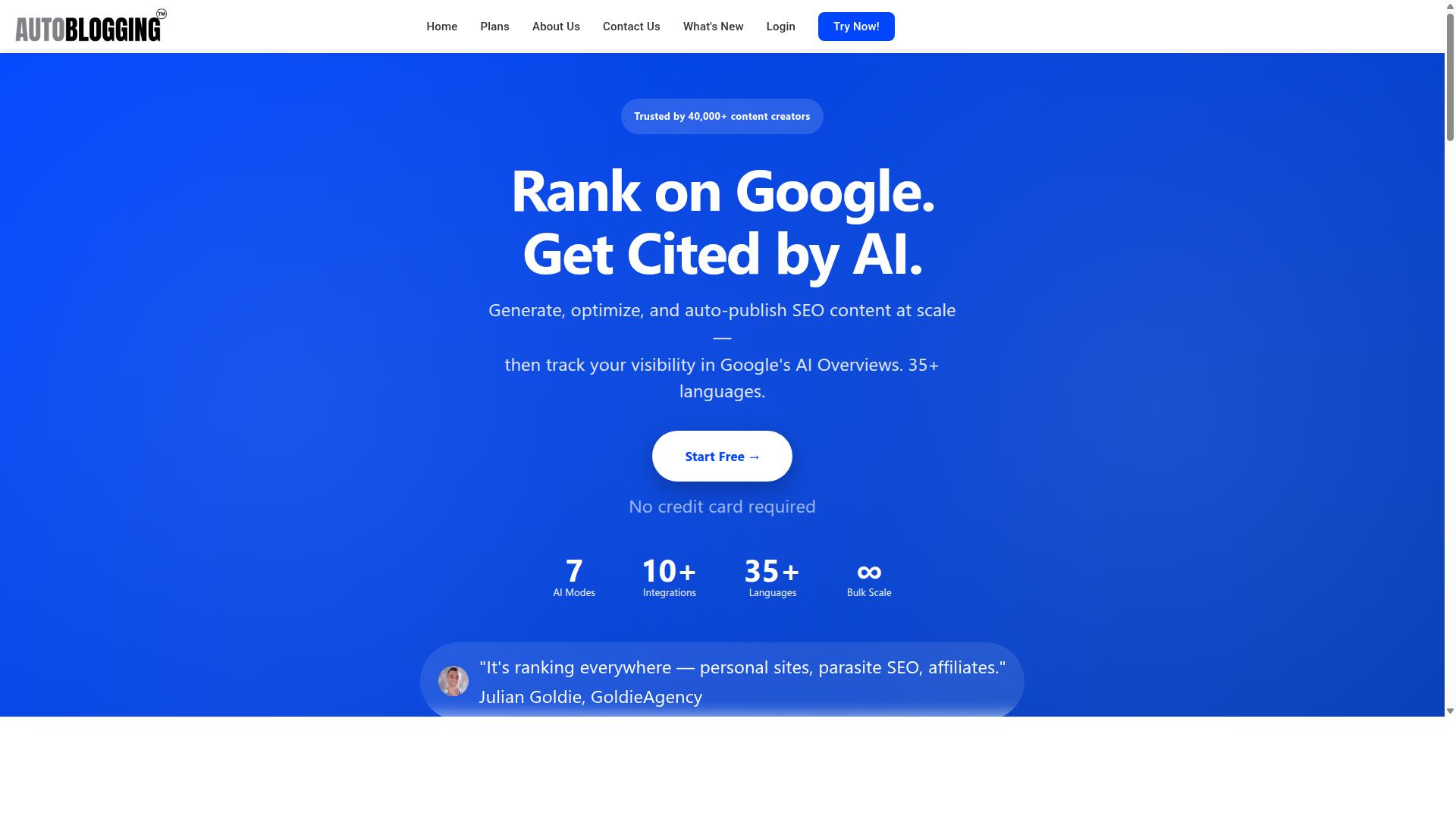
Autoblogging.ai is a SaaS platform that generates and publishes SEO-optimized articles directly to WordPress sites, eliminating manual copy-paste steps. It is a product of Digimetriq.com, founded in 2022 by Vaibhav Sharda.
The mission behind the platform is straightforward: help bloggers, website owners, and agencies save time and improve their online presence through cutting-edge technology. That focus on time savings is what separates a true direct WordPress publishing tool from a standalone AI writing software.
Autoblogging.ai is available globally and works as a content automation tool, not just a content generator. The platform aims to cut down content costs and give the power to human counterparts in SOPs with the first draft, while Digimetriq aims to replace human counterparts entirely.
Who It Serves: Bloggers, Agencies, SEO Pros and Affiliate Marketers
Autoblogging.ai targets a wide range of content creators, from solo bloggers to large marketing agencies and affiliate marketers. The platform's stated audience includes bloggers, website owners, SEO professionals, marketing agencies, content creators, and affiliate marketers.
That breadth matters because each group uses direct WordPress publishing differently. A solo blogger publishing to a personal site cares about removing the manual copy-paste step between drafting and going live. An agency managing client websites needs a content pipeline that keeps multiple publishing workflows moving without adding headcount.
Here is how the main user types tend to map onto the platform:
- Bloggers and content creators running personal sites or portfolio sites, who want a steady stream of SEO content without a full editorial team.
- SEO professionals handling parasite SEO and portfolio sites, where volume and consistency drive results.
- Marketing agencies producing content across client websites, where time saved per article compounds across every account.
- Affiliate marketers building and scaling affiliate sites, where bulk article creation feeds a growing content library.
- Website owners in local niches, who need location-relevant content published on a predictable schedule.
For every one of these groups, the benefit of a direct WordPress publishing platform is the same in principle: fewer steps between idea and live post. The mission to cut down content costs applies whether the user is one person or a team managing dozens of properties.
This is why the platform is positioned as more than a generator. A tool that only produces drafts still leaves the publishing workflow, the CMS synchronization, and the scheduling to the user. A direct publishing platform folds those steps into one content pipeline, which is exactly the gap that sends many buyers searching for a ZimmWriter alternative in the first place.
Why Direct WordPress Publishing Should Be Your First Buying Criterion
When evaluating AI writing tools, the ability to publish directly to WordPress without manual intervention is a critical differentiator that saves hours per week.
Manual publishing creates a predictable chain of friction. You copy text from a generator, paste it into the WordPress editor, fix broken headings and stray markdown, upload images one by one, and rebuild the formatting the tool stripped out. Then you schedule the post, only to repeat the whole routine for the next article.
That routine does not scale. A content automation tool with native WordPress integration removes the copy-paste step entirely. Errors drop because nothing is retyped, and a draft scheduling or auto-publish feature keeps your editorial calendar filled without daily manual effort. For anyone comparing a ZimmWriter alternative, direct publishing belongs at the top of the checklist.
One-Click WordPress Publish and What It Means for Your Workflow
One-click publishing transforms your content workflow by automatically transferring generated articles, including images and metadata, directly into your WordPress dashboard.
Technically, this happens through a connection layer. Tools generally link to WordPress via the REST API or XML-RPC, authenticate with an application password rather than your main login, and respect the user role permissions tied to that account. That matters for security and for multi-author sites where contributors should not publish as administrators.
A proper integration goes well beyond pushing plain text. Look for support across these areas:
- Post type support, including standard posts plus pages or custom post types
- Custom fields and taxonomy mapping, so categories and tags land in the right places
- Featured image handling and media library upload for inline visuals
- Markdown conversion and clean HTML formatting, avoiding broken shortcodes
- Gutenberg block editor compatibility, so blocks render correctly on arrival
Autoblogging.ai addresses this directly. Its WordPress integration covers unlimited sites with a one-click workflow, a plugin option, and scheduled auto-posting. That combination supports draft scheduling and true auto-publish, letting you line generated articles up against an editorial calendar instead of publishing reactively.
The practical result is a shorter content pipeline. Articles arrive formatted, categorized, and imaged, ready for review or immediate release. For a bulk article creation workflow, that difference compounds fast. Generating hundreds of pieces means little if each one still needs twenty minutes of manual assembly.
This is why direct WordPress publishing should anchor any buyer's guide. A ZimmWriter alternative that generates strong copy but leaves you hand-carrying it into WordPress solves only half the problem. CMS synchronization turns generation into a genuine end-to-end system, and that is the standard worth holding every SEO content generator to.
Evaluation Criteria for a ZimmWriter Alternative
When comparing ZimmWriter alternatives, focus on content quality, bulk generation capacity, integration options, and language support to ensure the tool meets your scaling needs.
These criteria separate tools that merely produce text from those built for a real publishing workflow. A writer may only need one strong article at a time, while an agency juggling multiple client sites needs volume, scheduling, and CMS synchronization.
Weigh each factor against your own operation. The sections below break down what to look for in SEO content generation depth and in the infrastructure that carries finished drafts to WordPress.
Content Modes, SERP Analysis and Semantic SEO Depth
Advanced content modes like Godlike Mode leverage SERP competitor analysis, LSI keyword extraction, and knowledge graph integration to produce semantically rich articles.
This matters because search engines reward topical authority, not just keyword placement. A tool that studies what already ranks can help you cover the subtopics and entities that top results share, which supports stronger semantic SEO.
Autoblogging.ai illustrates this range with its mode lineup. Quick Mode is free and suited to single articles or a guided wizard, while Godlike Mode applies SERP competitor analysis, LSI keywords, and knowledge graph extraction for deeper pieces. News Mode draws on Google News integration, and Amazon Reviews Mode targets product-focused content.
Beyond generation, optimization tools shape the final draft:
- Semantic SEO Analysis with a 21-point audit
- Snippet Optimizer for featured snippet targeting
- Topical Maps and Fan Out Queries for coverage planning
- Site Optimizer and Intense Optimizer for site-level tuning
- AI Proofreader plus a human proofreader included in all plans
Match the mode to the job. A quick news brief rarely needs the same depth as a pillar page competing for a valuable keyword, and paying for that depth on every post wastes effort. For buyers, the question is whether the SEO content generator you pick offers enough modes to cover both ends of that spectrum.
Bulk Generation, Integrations and Language Coverage
Bulk generation capabilities, extensive integrations, and multi-language support are essential for agencies and marketers managing multiple sites.
Volume alone is not enough if drafts still land in a folder for manual uploading. The real test is whether the content automation tool connects to the platforms where you publish and keeps an editorial calendar moving without constant intervention.
Autoblogging.ai addresses this side of the workflow directly. Its Bulk Generation mode produces up to 500 articles via CSV, and it reports 35+ integrations and support for 35+ languages. Publishing options include one-click WordPress publishing across unlimited sites through a plugin, with scheduled auto-posting and scheduled publishing built in. Multi-platform coverage extends to Shopify, Wix, Webflow, Blogger, and Ghost, plus Web 2.0 destinations like Medium, Dev.to, Hashnode, Telegraph, and Tumblr.
For teams with custom stacks, API connectivity is available alongside Zapier and n8n. A Content Repurposer and AI Infographics round out the pipeline, helping one piece of research feed several formats.
Language coverage opens additional markets, letting you serve audiences beyond English without rebuilding your process. The platform also reports credits that roll over, so unused capacity is not lost between cycles.
When you assess any ZimmWriter alternative, ask three questions: how many articles can it generate in one run, where can it publish without manual steps, and which languages does it handle? A tool that scores well on all three removes the bottleneck that usually stalls bulk article creation.
How Autoblogging.ai Measures Up Against These Criteria
Autoblogging.ai excels in direct WordPress publishing, offering a robust set of features that align with the evaluation criteria for a ZimmWriter alternative. Trusted by 40,000+ content creators, it carries a 4.9 average rating and has generated over 1M articles.
Its core strengths map directly onto what buyers should demand: multiple AI modes, broad integrations, multilingual output, and quality checks like a human proofreader on every plan. For bloggers, agencies, and SEO pros, that mix supports a dependable content pipeline rather than a one-off drafting tool.
The subsections below break down how each capability addresses real publishing needs.
10+ AI Modes: Quick, Godlike, Bulk, News and Amazon Reviews
Autoblogging.ai offers over 10 AI modes, each tailored for specific content types and workflows, from quick drafts to in-depth competitor analysis. That range matters in a buyer's guide because a ZimmWriter alternative should cover more than one job.
Here is how the named modes differ in purpose:
- Quick Mode: free, available as single and wizard options, suited to fast drafts and testing ideas.
- Godlike Mode: built around SERP competitor analysis, LSI keywords, and knowledge graph extraction, aimed at deeper SEO content.
- Bulk Generation: supports up to 500 articles via CSV, useful for agencies managing large content pipelines.
- News Mode: integrates with Google News for timely, news-driven content.
- Amazon Reviews Mode: designed for review-style content around products.
Alongside generation, optimization tools include a Site Optimizer, Semantic SEO Analysis with a 21-point audit, Snippet Optimizer, Topical Maps, Intense Optimizer, Fan Out Queries, AI Infographics, Outreach Prospects, an AI Proofreader, and a Human Proofreader. Featured snippet optimization helps target visible search results.
For a blogger, Quick Mode lowers the barrier to entry. For an SEO pro, Godlike Mode and the semantic tools support more competitive work. For an agency, Bulk Generation and the Content Repurposer keep output moving without manual rebuilding.
35+ Integrations, 35+ Languages and a Human Proofreader on Every Plan
With over 35 integrations, support for 35+ languages, and a human proofreader included in every plan, Autoblogging.ai ensures your content is both globally reachable and polished. For buyers comparing a ZimmWriter alternative, these three factors often decide whether a tool fits an existing workflow.
Integration matters because publishing should not require manual copy and paste. Autoblogging.ai connects to WordPress with unlimited sites, one-click publishing, a plugin, and scheduled auto-posting. It also supports Web 2.0 platforms like Medium, Dev.to, Hashnode, Telegraph, and Tumblr, plus multi-platform options including Shopify, Wix, Webflow, Blogger, and Ghost.
For teams that need programmatic control, there is an API, along with Zapier and n8n for connecting other systems. This kind of API connectivity and plugin compatibility keeps a content pipeline running without constant intervention.
Language support extends reach beyond a single market. A blog serving readers in multiple regions can produce localized content rather than relying on translation after the fact.
The human proofreader adds a quality assurance step that pure automation often lacks. Combined with credits rollover, 24/7 support, and new features shipped weekly, these selling points address the practical concerns bloggers, agencies, and SEO pros raise when choosing a direct WordPress publishing tool.
Pricing and Plans: What You Actually Pay
Autoblogging.ai offers transparent monthly and annual pricing plans, with credits that roll over, ensuring you only pay for what you use. That structure matters in a buyer's guide, because a ZimmWriter alternative is only worth switching to if the cost scales with your actual output. Autoblogging.ai keeps this simple: you pick a plan based on how many credits you need, and unused credits carry forward instead of expiring at the end of the month.
New accounts also receive 10 free credits per month with no credit card required, which gives you room to test the publishing workflow before committing to a paid tier.
The monthly lineup spans six tiers, from light single-site publishing to high-volume bulk article creation:
| Plan | Monthly Price | Credits |
|---|---|---|
| Starter | $19 | 40 |
| Regular | $49 | 120 |
| Standard | $99 | 300 |
| Gold | $179 | 600 |
| Premium | $249 | 1,000 |
| Enterprise | $999 | 5,000 |
Annual billing lowers the effective rate on every tier, which is where the real savings sit for anyone running a steady content pipeline:
| Plan | Annual Rate | Billed Yearly |
|---|---|---|
| Starter | $12/mo | $148/year |
| Regular | $32/mo | $382/year |
| Standard | $64/mo | $772/year |
| Gold | $116/mo | $1,396/year |
| Premium | $162/mo | $1,942/year |
| Enterprise | $649/mo | $7,792/year |
Comparing value by scale is straightforward. A solo blogger publishing a handful of posts a week fits comfortably in Starter or Regular. An agency managing several client sites, each with its own editorial calendar and publishing workflow, tends to land around Standard or Gold. Teams running aggressive bulk article creation across many domains will find Premium or Enterprise more economical per credit than stacking multiple mid-tier subscriptions.
Credit rollover changes the math further. If your output dips in a slow month, those credits remain available for a heavier push later, so you are not paying twice for the same capacity. Additional credits can be purchased whenever you need a short-term boost without changing tiers.
For buyers who would rather not run the software themselves, Done For You packages are priced separately: Starter at $1,200 for 1,000 articles, Pro at $1,600 for 1,000 articles, Corp at $4,000 for 1,000 articles, and Senpai at $10,000 for 1,000 articles. Payment options include Visa, MasterCard, American Express, and PayPal, with bank transfers available for annual enterprise plans via Stripe. You can cancel anytime, so there is no long-term lock-in if your publishing needs change.
Trust Signals: Track Record, Ratings and Testimonials
Autoblogging.ai is trusted by over 40,000 content creators, boasts a 4.9 average rating, and has generated more than 1 million articles, backed by testimonials from industry leaders. Those numbers matter in a buyer's guide because they answer the question every marketer asks before switching tools: has this platform already proven itself at scale?
When you evaluate any ZimmWriter alternative, track record should carry real weight. A tool with a long list of active users and a high average rating has survived contact with real publishing workflows, not just a demo environment. Autoblogging.ai's 1 million plus generated articles reflect exactly the kind of bulk article creation that agencies and niche site owners depend on.
Independent voices reinforce the platform's reputation. Testimonials come from:
- Julian Goldie (GoldieAgency, 250k+ YouTube subscribers)
- James Dooley (FatRank, PromoSEO)
- Bart Magera (MojoLinks)
- Kyle Duncan (SEO Professional)
- Dimitar Georgiev (CEO, IDEAMAX.EU)
- Cagri Sarigoz (Founder, Cagri Sarigoz LLC)
- Jacky Chou (Indexsy)
These are practitioners who run content operations daily, from agency owners to SEO professionals. Their public endorsements give prospective buyers a reference point beyond anonymous reviews. For anyone weighing an AI writing software purchase, third-party credibility from recognizable names is a meaningful signal.
Support and product momentum round out the picture. Autoblogging.ai provides 24/7 support alongside weekly feature updates, which matters when your content pipeline depends on a tool staying current with WordPress changes. The company also runs a YouTube channel for SEO education and offers related products including Digimetriq.com and AutoLinking.ai.
For a buyer comparing options, this combination of scale, ratings, named testimonials, and ongoing development is about as strong a trust profile as you will find in the content automation tool space. It is a clear sign that the platform is a legitimate, established choice for direct WordPress publishing.
Who Should Use Autoblogging.ai - and Final Verdict
Autoblogging.ai is ideal for bloggers, agencies, SEO professionals, and affiliate marketers who need to scale content production with direct WordPress publishing. These are the users who feel the friction of manual workflows most sharply: drafting in one tool, formatting in another, then uploading post by post.
For each of these groups, the value proposition is similar. A content automation tool that connects straight to WordPress removes repetitive steps from the publishing workflow, so effort shifts from logistics to strategy.
- Bloggers managing a single site or a small portfolio who want steady output without hiring a writing team.
- Agencies producing content for multiple client sites, where consistency and turnaround time drive retention.
- SEO professionals building topical coverage across many pages, where an SEO content generator supports volume and structure.
- Affiliate marketers running review and comparison sites that depend on frequent, well-organized posts.
If your workflow already lives inside WordPress and you publish often, Autoblogging.ai fits naturally into that routine. If you publish rarely or prefer writing entirely by hand, the advantage is smaller.
As a ZimmWriter alternative, the deciding factor is direct WordPress publishing. Buyers comparing tools in this category should weigh how much of the publishing workflow happens inside the platform versus outside it, and how much manual handling remains after the draft is finished.
On that measure, Autoblogging.ai is a strong fit for teams that want their content pipeline to end at the WordPress dashboard rather than at a download folder. It is built for scale, and it serves the users who need scale most.
Support is another practical consideration in any buyer's guide. Autoblogging.ai lists contact channels across two regions, which matters when publishing schedules are tight.
| Region | Address | Phone |
|---|---|---|
| India | 501, Trinity Orion, Vesu, Surat - 395007, Gujarat, India | +91 84605-06553 / +91-8460506553 (Phone/WhatsApp) |
| United Kingdom | 2nd Flr, SEO Content Suite, 35 Water Ln, Wilmslow, Cheshire SK9 5AR | +44 1625 359056 |
Email reaches the team at [email protected], and Skype contact is available at vibes.yb. Support hours run 7:00-19:00 IST. The brand also maintains a presence on Facebook, Twitter, and LinkedIn.
Final verdict: Autoblogging.ai is a credible, well-suited choice for anyone who needs a ZimmWriter alternative centered on direct WordPress publishing. It targets exactly the users who benefit most from automation, and its published contact details make it easy to evaluate before committing. For bloggers, agencies, SEO professionals, and affiliate marketers, it deserves a place at the top of the shortlist.
Frequently Asked Questions
What should I look for in a ZimmWriter alternative if direct WordPress publishing is my priority?
The most important feature is a native, built-in WordPress integration that lets you push generated articles straight to your site without copy-pasting or third-party connectors. Autoblogging.ai offers 35+ integrations and is built to fit directly into publishing workflows for bloggers, agencies and affiliate marketers. Beyond publishing, check that the tool also handles the SEO side - keyword research, competitor analysis and internal linking - so you're not stitching together multiple subscriptions.
How does Autoblogging.ai compare to ZimmWriter for bulk content production?
Autoblogging.ai supports Bulk Generation of up to 500 articles via CSV, which makes it practical for agencies and portfolio-site owners managing content at scale. It also includes 10+ AI modes, including Godlike Mode with SERP competitor analysis, LSI keyword extraction and knowledge graph data, plus a dedicated News Mode. Rather than comparing feature lists line by line, evaluate which tool matches your actual publishing volume and whether the output quality holds up on your own test batch.
Is Autoblogging.ai a good fit for agencies publishing to client WordPress sites?
Yes - agencies are one of the core audiences Autoblogging.ai is built for, alongside bloggers, SEO professionals and affiliate marketers. The platform is trusted by 40,000+ content creators, holds a 4.9 average rating, and has generated over 1M articles, so it's proven at agency-level volume. Credits also roll over, which helps agencies avoid wasting spend during slower months.
What does Autoblogging.ai cost compared to other ZimmWriter alternatives?
Autoblogging.ai uses a credit-based model with monthly plans starting at $19 for 40 credits and scaling up to $999 for 5,000 credits, with annual billing options available. Because competitors structure pricing differently - some are one-time purchases, others subscription-based - the fairest comparison is cost per published article rather than the headline price. Factor in whether credits roll over and whether support and proofreading are included before deciding.
Does Autoblogging.ai include human proofreading and support?
Yes. A human proofreader is included in eligible plans, which is unusual for AI writing tools and useful if you publish directly to client or money sites. Autoblogging.ai also provides 24/7 support and ships new features weekly, so the platform keeps improving after you buy. If proofreading matters to your workflow, confirm which plan tier includes it before purchasing.
Can Autoblogging.ai handle multilingual content and SEO-focused articles?
Autoblogging.ai supports 35+ languages, making it suitable for local sites, international portfolios and multi-market client work. Its Godlike Mode pulls SERP competitor analysis, LSI keywords and knowledge graph data to produce SEO-oriented drafts rather than generic text. For direct WordPress publishing across several regions, that combination of language coverage and on-page SEO input is a meaningful advantage.
Recommended Resources: